Smart Export Guarantee (SEG) and UK solar incentives explained
The Smart Export Guarantee (SEG) lets households and businesses earn money from renewable electricity exported to the grid. Alongside SEG, UK incentives can help reduce the upfront cost of installing solar panels. This guide explains how SEG works, who is eligible, how to access it, and which support options may be available based on your location and circumstances.
Contents:
- What is the Smart Export Guarantee (SEG)?
- SEG eligibility and requirements
- How to apply for a SEG tariff
- How SEG payments work and how much you could earn
- Other solar panel incentives
- If you are not eligible for grants
- Frequently asked questions
- Get help choosing the right solar setup
What is the Smart Export Guarantee (SEG)?
The Smart Export Guarantee is a government-backed scheme introduced in January 2020. It requires certain licensed electricity suppliers to pay households and businesses for renewable electricity exported to the national grid.
SEG is not a grant. Instead, it provides ongoing payments for surplus electricity generated by systems such as solar panels. You are only paid for electricity you export, not the electricity you use in your home or business.
Energy suppliers set their own SEG tariffs, contract lengths and terms, but the export rate must always be above zero. You do not have to use the same company for your electricity supply and your SEG tariff.
SEG eligibility and requirements
To receive Smart Export Guarantee payments, your solar panel system must meet a few technical requirements.
- A suitable export meter: You’ll need a meter that can measure how much electricity you send back to the grid. In most cases, this is a smart meter capable of half-hourly export readings.
- Certified installation: Your solar panels and installer must normally be certified under the Microgeneration Certification Scheme (MCS), or another certification scheme accepted by your chosen energy supplier.
- No overlap with older schemes: If you are still receiving export payments under the Feed-in Tariff (FiT) scheme, you cannot also receive SEG payments for the same exported electricity.
Note: SEG applies in Great Britain (England, Scotland and Wales). It does not apply in Northern Ireland, where different export arrangements and funding schemes may be available.
How to apply for a SEG tariff

To access SEG payments, you apply directly to an energy supplier that offers a SEG tariff. Each supplier has its own application process and tariff structure.
When comparing options, it is worth considering:
- Export rate: The price you are paid per kWh, which can be fixed or variable.
- Contract length: How long the SEG tariff runs before you can switch.
- Payment frequency: How often you receive SEG payments.
- Higher rates for existing customers: Some suppliers offer better rates if you also buy electricity from them.
- Battery ownership: Having a solar battery can affect the export rate offered.
SEG tariffs change over time, so reviewing your export tariff periodically can help you stay on a competitive rate.
How SEG payments work and how much you could earn
As a rough guide, many households earn between £50 and £300 per year from SEG payments, though this can be higher or lower depending on export levels and tariff choice.
Once you are signed up to a SEG tariff, you are paid for each unit of electricity you export to the grid. Payments are usually made monthly or quarterly, depending on the supplier.
SEG tariffs range from around 1p per kWh on some basic tariffs to 15p per kWh or more on many competitive options, with certain tariffs offering rates of up to around 30p per kWh under specific conditions, such as time-of-use pricing or bundled battery setups.
How much you earn depends on:
- The size of your solar panel system
- How much electricity you export rather than use yourself
- The export rate offered by your supplier
Setting up SEG payments can take time. Suppliers usually require documents such as your MCS certificate, smart meter details and, in some cases, an export MPAN. The full process can take around 5 to 12 weeks before payments begin.
Other incentives for solar panels
SEG provides income over time, but it does not reduce installation costs. The following incentives may help lower the upfront price of solar panels.
Northern Ireland Sustainable Energy Programme (NISEP)
In Northern Ireland, support for energy efficiency and renewable technologies is delivered through the Northern Ireland Sustainable Energy Programme (NISEP).
The scheme is funded through energy suppliers and supports a range of projects aimed at reducing energy use and carbon emissions.
Solar panels may be supported in certain cases, typically through approved projects rather than direct household grants. Availability depends on supplier-led delivery and eligibility criteria, and support can vary over time.
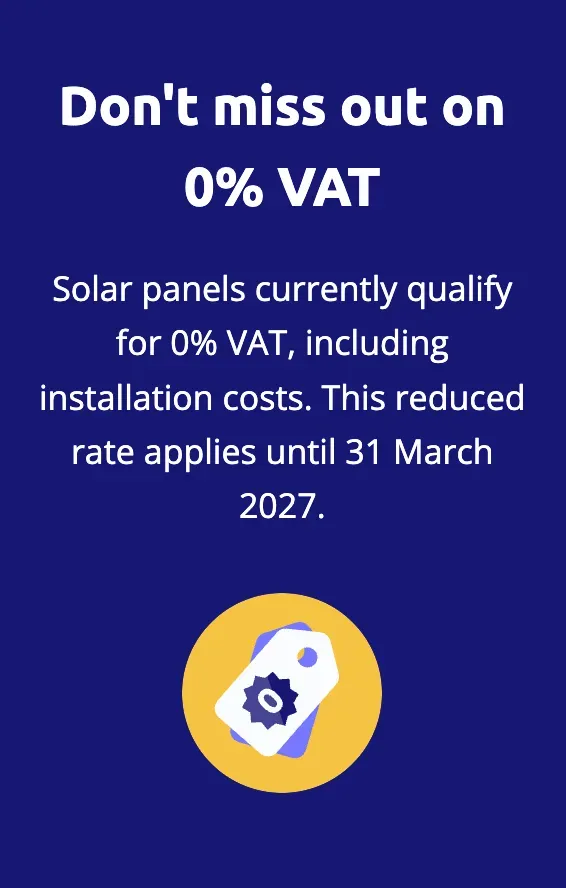
0% VAT on solar panel installations
Domestic solar panel installations currently benefit from a 0% VAT rate on supply and installation. This applies across England, Scotland, Wales and Northern Ireland and can significantly reduce upfront costs.
The VAT reduction can also apply to solar batteries, including standalone battery installations, depending on how the work is supplied and contracted.
Solar Together group-buying scheme
Solar Together is a council-backed group-buying scheme designed to reduce the cost of solar panels and batteries through collective purchasing.
Homeowners can apply to take part in the scheme, as can tenants who have their landlord’s permission to install solar panels. In some areas, small and medium-sized enterprises and commonhold associations are also eligible to participate.
Availability depends on whether a local authority is running a Solar Together scheme, which can vary by location and may change over time.
ECO4
The Energy Company Obligation (ECO4) is a specific government funding scheme delivered through energy suppliers. It focuses on improving energy efficiency in homes with lower energy performance ratings.
In some cases, ECO4 funding can include solar panels, but usually only as part of a wider package of measures, such as insulation or heating upgrades.
Eligibility is tightly defined and linked to property efficiency and household circumstances, rather than open applications. ECO4 operates in England, Scotland and Wales and is scheduled to run until the end of 2026.
Warm Homes support
Warm Homes is not a single grant scheme, but a broader framework that brings together different government-backed programmes to improve home energy efficiency.
Support is typically based on an individual property assessment. Solar panels may be included where appropriate, but most homeowners will not receive fully funded installations.
Instead, Warm Homes support often works alongside other incentives, such as 0% VAT, Smart Export Guarantee payments and financing options. In Wales, this support is delivered through the Warm Homes Nest scheme, which provides energy advice and tailored home improvements.
Optimised Retrofit Programme (ORP)
The Optimised Retrofit Programme (ORP) is a Welsh Government scheme that supports energy efficiency upgrades in social housing. This can include solar panels as part of wider retrofit projects, but it is aimed at housing providers rather than individual homeowners.
If you are not eligible for grants
Even if you don’t qualify for government grants, there are still several ways to reduce the cost of going solar:
- 0% VAT on solar panel installations
- Smart Export Guarantee (SEG) payments for electricity you export
- Lower energy bills by using more of your own electricity
You can also spread the cost through solar finance options, including loans, green mortgages, installer finance and subscription plans.
- Check eligibility, such as UK residency and property ownership
- Understand how credit checks and affordability may apply
- Compare quotes from multiple installers
- Review the full cost of borrowing, not just monthly payments
Frequently asked questions
Are there government grants for solar panels?
Yes, there are government-backed schemes that can include solar panels, but they are usually delivered through energy suppliers or local authorities and come with strict eligibility criteria.
In practice, most homeowners reduce costs through a combination of 0% VAT, Smart Export Guarantee (SEG) payments, and finance or payment plans, rather than receiving a direct grant.
Are grants available for tenants and landlords?
In some cases, yes. Tenants typically need their landlord’s permission before solar panels can be installed.
Certain schemes support private rented properties where energy efficiency improvements are needed, but availability depends on location, property type and scheme rules.
What is the difference between grants and SEG?
Grants and funding schemes reduce the upfront cost of installing solar panels.
The Smart Export Guarantee (SEG), on the other hand, provides ongoing payments for surplus electricity you export to the grid after your system is installed.
Many households use SEG alongside other incentives rather than instead of them.
How do I check if I’m eligible for a solar panel grant or loan?
Eligibility depends on factors such as where you live, your property’s energy efficiency and household circumstances. Some schemes are aimed at households receiving certain benefits, while others offer loans rather than grants.
You can get guidance from government-backed services such as Simple Energy Advice, Home Energy Scotland, or NI Direct, or speak with a certified installer who can explain which options may apply to your home.
Can I get free solar panels?
Fully funded solar panel installations are only available in limited cases through specific schemes, such as ECO4 in England, Scotland and Wales, or Warm Homes Nest in Wales, and are subject to strict eligibility criteria.
Standalone Home Energy Scotland grants for solar panels ended in June 2024. Most homeowners will need to pay for installation, but can still significantly reduce costs through 0% VAT, SEG payments, and solar finance options.
- MoneySavingExpert – SEG tariffs and solar export rates
- GOV.UK – Smart Export Guarantee (SEG)
- GOV.UK – Warm Homes Local Grant
- Welsh Government – Warm Homes Nest programme
- Energy Saving Trust – Northern Ireland Sustainable Energy Programme (NISEP)
- GOV.UK – ECO4 end date consultation
- Solar Together – Council-backed group-buying scheme
- Welsh Government – Optimised Retrofit Programme (ORP)
Get advice from trusted installers
A certified installer can help confirm which incentives apply to your home, ensure your system qualifies for SEG payments, and factor in 0% VAT and other cost-saving options.
Solarenergy.co.uk lets you compare offers from qualified local installers for free, so you can explore your options and decide what works best for your home, with no obligation.
Pick the best offer
You can easily compare the offers and find out what is most important to you.
All you need to do is fill out our short form with your needs.

Save the environment
Investing in solar energy is an environmentally friendly measure that saves the environment whilst simultaneously lowering your electricity bills.

Free and non-binding
It's free and non-binding to receive offers through Solarenergy.co.uk.
If you're not satisfied with any of the offers, you can easily decline them all.

Save time
Skip the hassle of chasing companies that offer good solar energy systems. Let the suppliers come to you instead.
Save money
Get offers from up to four competing solar suppliers and choose the one that meets your needs the most.
Free and non-binding
Choose whether you want to accept an offer or not. If you're not happy with any of them, you're free to decline them all.
Our awards